Coming soon. Fiber to the Room is launching with UbiFi soon. Join the waitlist and we will contact you first with availability and plans for your home.
What is Fiber to the Room?
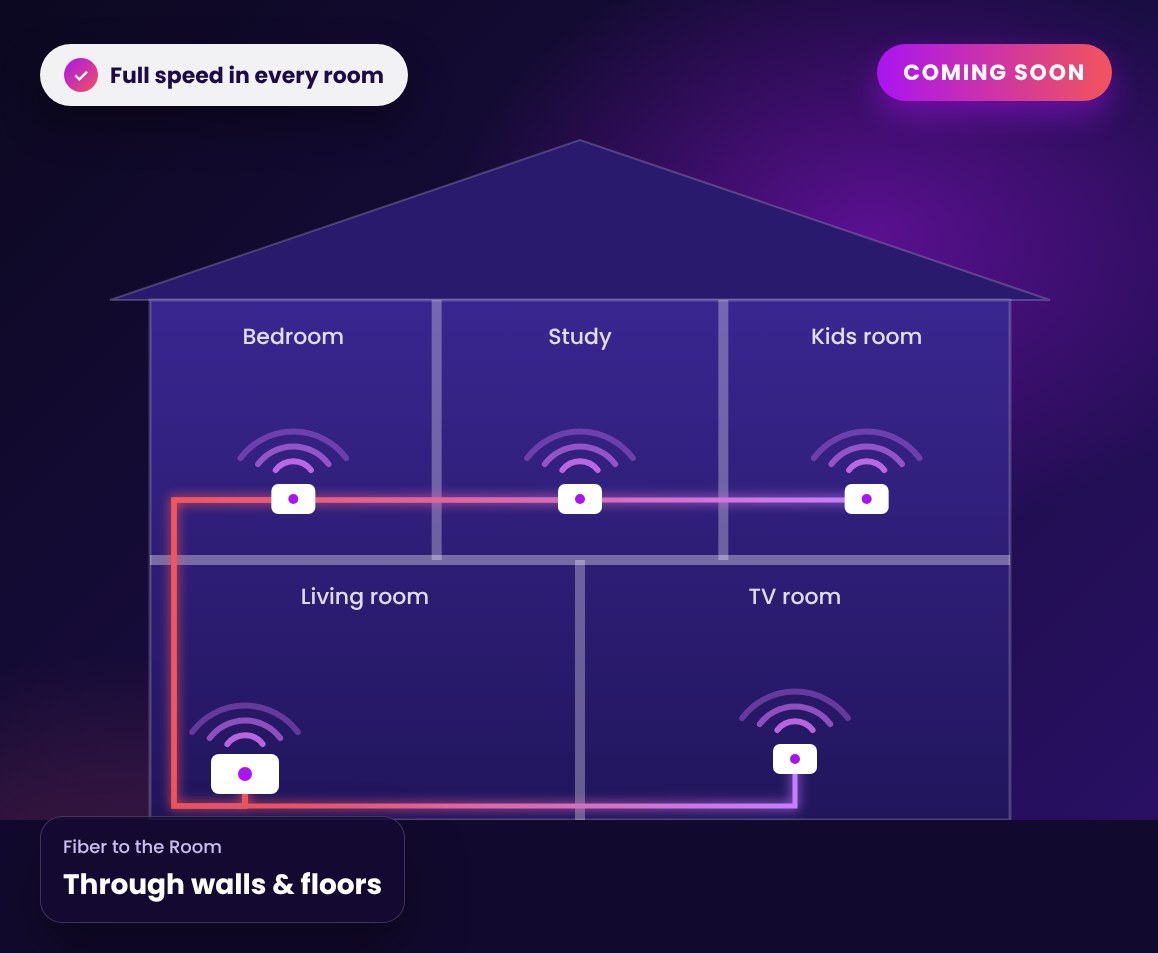
Fiber to the Room — FTTR — extends fiber beyond your main router to the rooms where you actually use the internet. A main gateway connects to small room units over ultra-thin optical fiber, and each room unit creates fast, local Wi-Fi. Together they work as one seamless network.
Why Wi-Fi struggles in bigger homes
- Thick walls and floors — concrete, brick and slabs weaken Wi-Fi signals room by room.
- Multiple floors — upstairs bedrooms, terraces and studies are often far from the router.
- Many devices — phones, TVs, laptops and smart devices all compete for the same signal.
- Wireless extenders — repeaters share bandwidth over the air, so speeds drop at every hop.
How FTTR works
01
Main gateway
Your fiber connection arrives at a main FTTR gateway, just like today's router.
02
Fiber to each room
Hair-thin fiber is laid neatly along skirting, corners or existing conduits to the rooms you choose.
03
Room units
A compact unit in each room delivers strong Wi-Fi and wired ports right where you need them.
04
One seamless network
Devices move between rooms without dropping calls or games, managed as a single Wi-Fi network.
FTTR compared with mesh Wi-Fi
| Wireless mesh | Fiber to the Room | |
|---|---|---|
| Link between units | Wi-Fi, shared over the air | Dedicated fiber |
| Speed in far rooms | Drops with walls and hops | Close to full plan speed |
| Latency for gaming & calls | Varies | Low and consistent |
| Many devices at once | Can congest | Each room has its own access point |
| Installation | Plug-in units | Discreet fiber laid by our engineers |